
Understanding "Nautilus", Verifiable Offchain Privacy on Sui.
Exploring Mysten Labs innovative products

Imagine you have a super-secure vault that can do calculations and fetch data from the internet, but nobody can tamper with it or see what's inside. That's basically what Nautilus does for applications.
Before diving into Nautilus, it is important to first understand the problem it's solving. First off, blockchains were designed for transparency, every transaction, piece of data and computation is visible to all participants, creating a significant problem, Privacy.
For example, in the healthcare industry, patient records need to be secure and verifiable, but they can't be publicly visible on the blockchain. Traditional blockchain solutions force developers into an impossible choice: sacrifice privacy for transparency or sacrifice transparency for privacy. This dilemma has limited blockchain adoption in industries dealing with sensitive data.
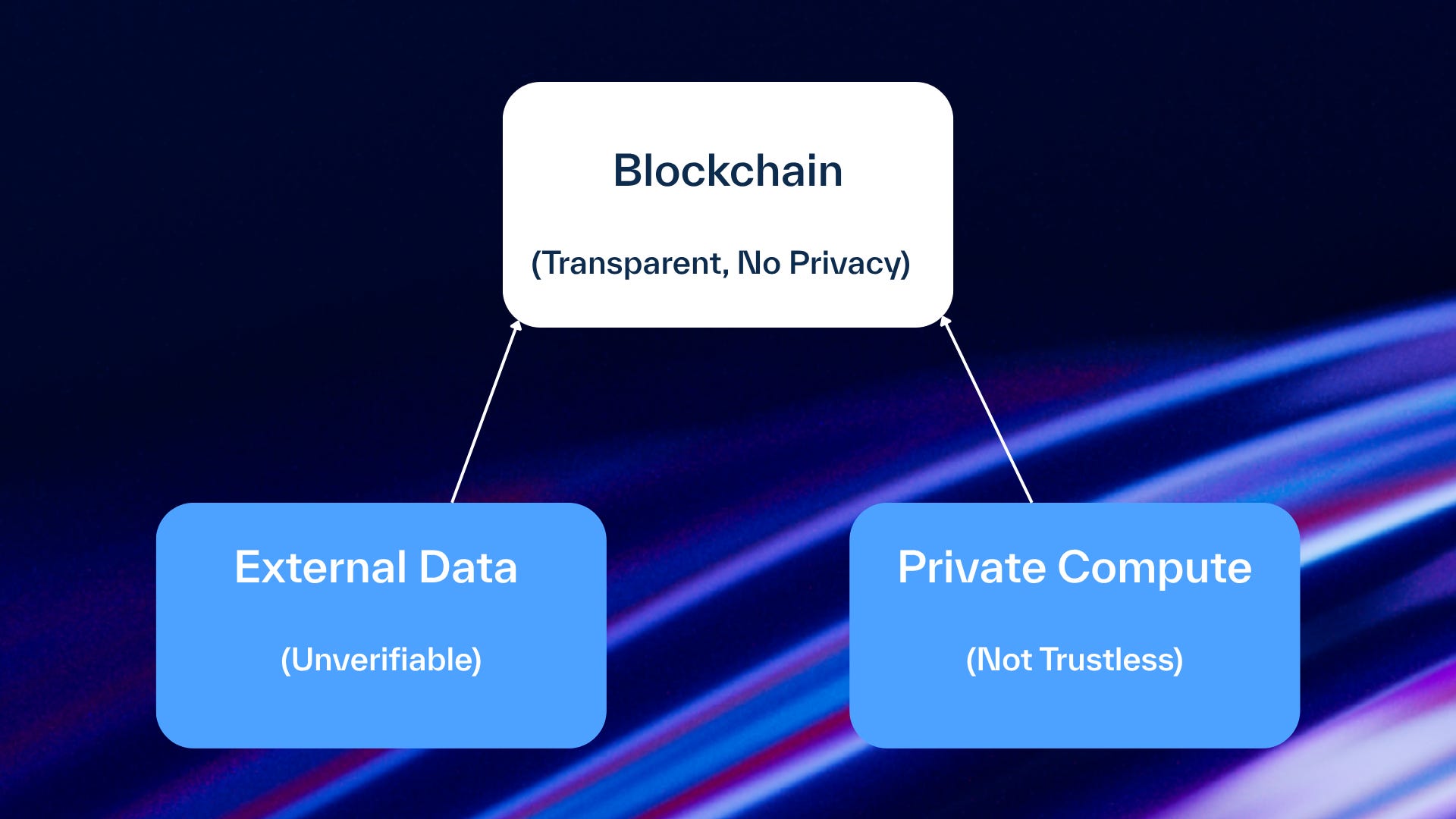
With this understanding, let's now view Nautilus as a revolutionary solution.
Nautilus fundamentally reimagines how blockchains handle sensitive computations and external data. Instead of forcing everything onto the public blockchain, Nautilus introduces a hybrid architecture that combines the best of both worlds:
The security and verifiability of blockchain with the privacy
Performance of off-chain computation
Nautilus leverages Trusted Execution Environments (TEEs), specifically AWS Nitro Enclaves in its current implementation. But what makes Nautilus special isn't just the use of TEEs, it's how it integrates them seamlessly with the Sui blockchain to create a verifiable, trustless system for off-chain computation.
What is a Trusted Execution Environment (TEE)?
A TEE is like a secure vault within a computer. It's an isolated area of a processor that guarantees code and data loaded inside are protected with respect to confidentiality and integrity. Even the cloud provider (like Amazon) cannot see inside this vault. The TEE can prove exactly what code is running inside it through a process called attestation, creating a cryptographic fingerprint that can be verified by anyone.
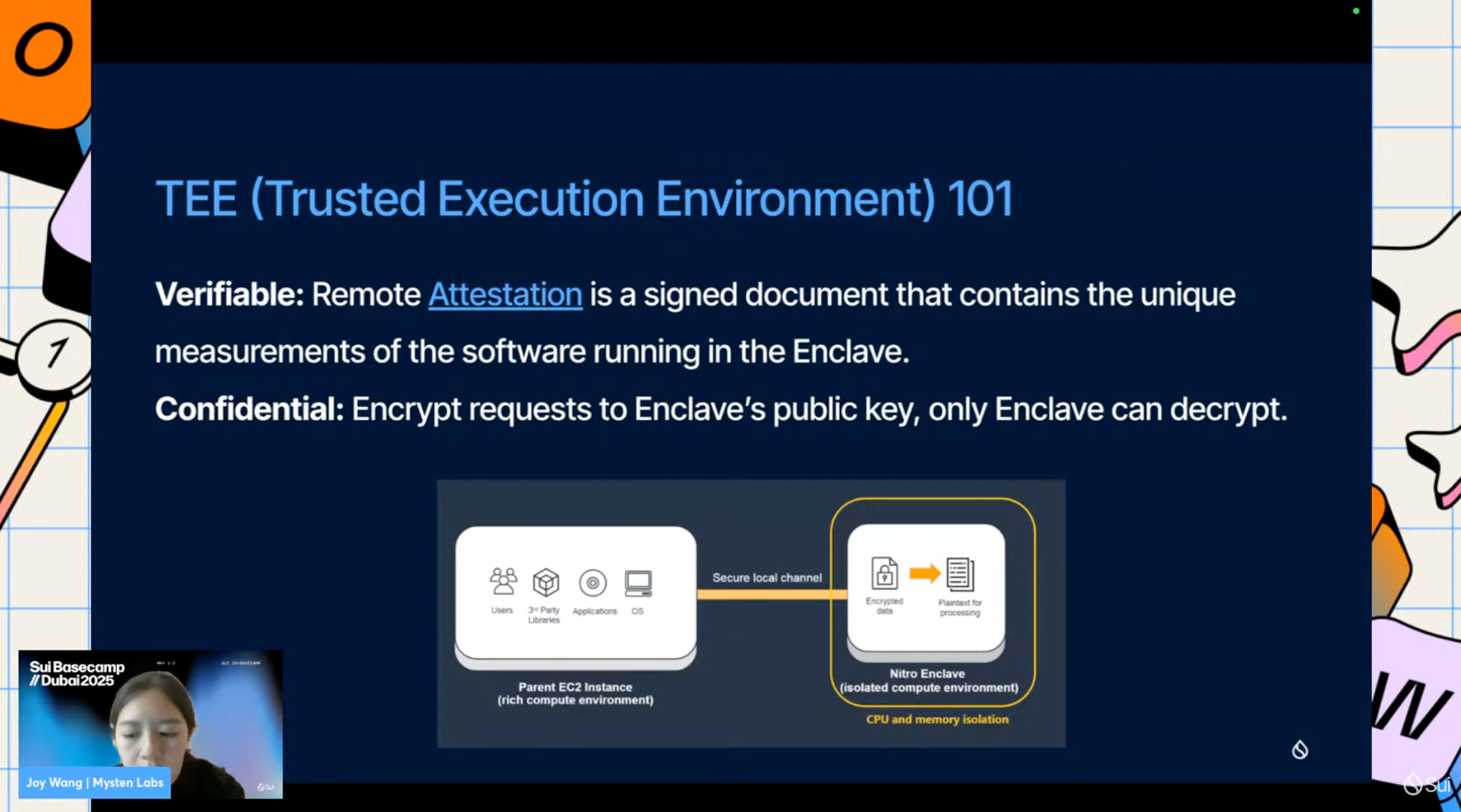
"Native Crypto Features", explained by Joy Wang in the Sui Overflow tutorial series.
Technical Overview of Nautilus
The framework, Nautilus, operates through a carefully orchestrated sequence of cryptographic operations and verifications that ensure both privacy and trustlessness.
The journey begins with AWS Nitro Enclaves, Amazon's implementation of TEE technology. These enclaves provide several critical security properties: they run on isolated CPU cores with dedicated memory, they have no persistent storage, no external networking except through a carefully controlled channel, and most importantly, they generate cryptographic attestations that prove exactly what code is running inside them.
When a developer deploys a Nautilus application, they first write their sensitive computation logic, whether that's fetching price data, performing private calculations, or verifying user credentials. This code is then compiled into an Enclave Image File (EIF), which is essentially a specialized virtual machine image designed to run in the secure enclave.
Also, take note of this term called "PCR Values". Platform Configuration Registers (PCRs) are like DNA for your enclave. They're cryptographic hashes that uniquely identify the exact code and configuration running in the TEE. PCR0 represents the enclave image file, PCR1 represents the Linux kernel and boot parameters, and PCR2 represents the application. Any change to the code, no matter how small, results in completely different PCR values, making it impossible to tamper with the enclave without detection.
Nautilus isn't just bolted onto Sui, it's deeply integrated with Sui's unique architectural features. Sui's object-centric model, parallel transaction processing, and Move programming language create the perfect foundation for Nautilus's hybrid computation model.
Sui's object model allows Nautilus attestations to be treated as first-class objects on the blockchain. This means attestations can have complex ownership rules, can be composed with other objects, and can participate in Sui's innovative programmable transaction blocks. A single transaction can register an enclave, verify multiple attestations, and update numerous on-chain states atomically.
Move Smart Contract Integration
Move's resource-oriented programming model is ideal for managing Nautilus attestations. Attestations are basically resources that cannot be copied or discarded, which ensure that verification results are handled safely. Move's formal verification capabilities also allow developers to mathematically prove that their verification logic is correct.
Use Cases for Nautilus
While Nautilus’s ability to deliver tamper-resistant oracle data is significant, it merely scratches the surface. The real value of Nautilus lies in unlocking entire categories of decentralized applications that previously faced fundamental limitations.
Private DeFi & Regulatory Compliance
Imagine a decentralized exchange needing to comply with KYC/AML laws while preserving user privacy. With Nautilus enclaves, identity checks and blacklist verifications are performed securely off-chain. Regulatory compliance is cryptographically attested without exposing any sensitive user data.
2. Verifiable AI Inference
AI models can now run securely inside enclaves, with outputs verifiable on-chain. This is critical for high-stakes use cases like automated moderation or decentralized decision systems.
3. Decentralized Identity
Digital identity verification typically requires sharing excessive personal information. Nautilus enables zero-knowledge identity verification where users can prove specific attributes (age, citizenship, qualifications) without revealing any other personal data, revolutionizing privacy-preserving compliance.
4. Private Analytics Platform
Modern businesses need detailed analytics to improve their services, but users increasingly demand privacy protection. Nautilus enables organizations to gain valuable insights from user behavior while guaranteeing that individual users cannot be identified or tracked, creating a win-win for privacy and business intelligence.
5. Voting Systems
Nautilus revolutionizes digital voting by solving the fundamental challenge of democratic elections: maintaining ballot secrecy while ensuring transparent, verifiable results. Traditional blockchain voting systems face an impossible choice between transparency (making all votes public) and privacy (losing verifiability). Nautilus elegantly solves this dilemma.
Conclusion
Nautilus represents more than just a technical innovation, it's a fundamental reimagining of what blockchain applications can be. By solving the privacy paradox and the oracle problem simultaneously, Nautilus opens doors to use cases that were previously impossible.
For developers, Nautilus offers the tools to build applications that respect user privacy while maintaining blockchain's security guarantees. For users, it means access to decentralized services that can handle sensitive data responsibly and for enterprises, it provides a bridge between the efficiency of private systems and the trust of blockchains.
Start building on Nautilus: https://github.com/MystenLabs/Nautilus
References
Native Crypto Features -
AWS Nitro Enclaves -
https://docs.aws.amazon.com/enclaves/latest/user/
Nautilus on Sui Website -
Sui Blog Post:
Solid work 👨🍳